
- Producing only when needed.
- Choosing materials with lower impact.
- Designing products that last longer.
- Reducing waste in packaging.
- Keeping production closer to the customer.
As Earth Day comes closer, more brand owners are starting to rethink how their products are made. Not just how they look—but how they exist. Sustainability in fashion is often reduced to labels like organic, recycled, or eco-friendly. But in 2026, that thinking is evolving. The real conversation is shifting from what you make to how much you make.
And that’s where eco-friendly print-on-demand begins to stand out.
Why Eco-Friendly Print on Demand Matters More Than Ever in 2026
The demand for eco-friendly clothing is no longer niche. Customers are paying attention. They are asking questions. They are choosing brands that reflect their values. But here’s the shift: people are also becoming more aware of greenwashing.
Just calling something “sustainable” is not enough anymore.
A truly sustainable print-on-demand clothing brand is built on decisions that reduce waste, improve efficiency, and respect resources at every step.
The Real Problem in Fashion: Overproduction
There is a deeper issue behind fashion waste, and it’s not just materials. Its volume. For years, the industry has worked on prediction, producing thousands of units before knowing if they will sell. When they don’t, those products sit, get discounted, or are simply discarded. That’s where the real damage happens.
As Mahatma Gandhi once said,
“Nature has enough for everyone’s need, but not for everyone’s greed.”
This applies directly to fashion today. Even eco-friendly clothing becomes waste if it is overproduced.
How Print on Demand Solves the Overproduction Problem
This is where print-on-demand clothing changes the system. Instead of producing in bulk, you produce only when an order is placed.
No guessing. No excess.
This model removes the need to hold inventory and avoids the cycle of unsold stock. It aligns production with real demand, which is what makes sustainable POD so effective. You are not just choosing better materials, you are choosing a better way to produce.
Choosing Better Garments (But in the Right Way)
Materials still matter. But they work best when paired with controlled production. A thoughtful product made in smaller quantities will always be more responsible than a “perfect” fabric produced in excess.
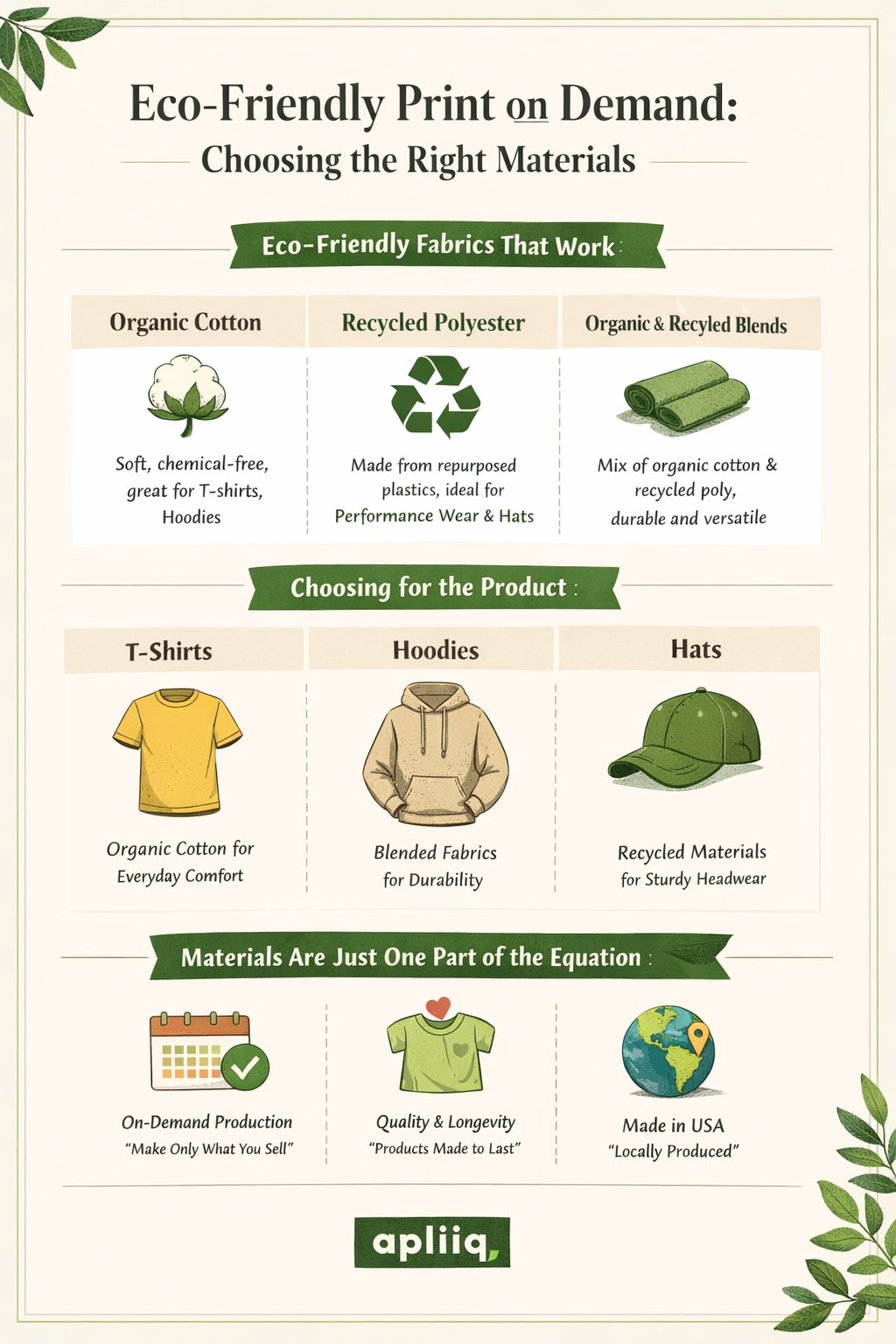
Explore Eco-Friendly Product Categories
If you’re building your catalog, start with proven winners:
- Eco-friendly tees
- Sustainable hoodies
- Recycled hats: a good example is the As Colour Surf Cap 1114, made from recycled nylon.
- Everyday essentials
When building your product line, consider options such as organic cotton and recycled fibers. These materials reduce environmental impact at the sourcing level. If you’re looking to explore options, Apliiq offers a range of Apliiq’s Eco-Friendly Clothing that aligns with this direction.
Made in USA & Smarter Sourcing
Where your product is made also matters; producing closer to your customers reduces shipping distance, which lowers fuel use and delivery time. With Apliiq’s facilities in Los Angeles and Philadelphia, production can stay closer to the end customer instead of moving across long global routes.
This is a quieter part of sustainability, but an important one.
Why Durability is a Key Part of Sustainable Fashion
One of the most overlooked aspects of sustainable fashion is product longevity. If something is worn for years, it naturally reduces waste. If it is worn a few times and replaced, even the best materials cannot fix that.
This is why durability matters, and that’s why we always recommend:
- Heavyweight garments
- High-quality construction
- Long-lasting materials
Eco-Friendly Packaging for Print on Demand
Packaging is often the first physical interaction a customer has with your brand. It is also one of the easiest areas to improve. Many brands are now moving toward eco-friendly packaging for print-on-demand, using options such as paper mailers or recycled poly mailers instead of traditional plastic-heavy packaging.
Custom Packaging Flexibility
What makes this more powerful is control. With Apliiq, brands have the option to send in their own custom packaging. You’re not locked into a single format—you can choose materials that align with your brand, whether that’s paper mailers, recycled options, or something else that fits your direction.
At the same time, it’s important to say this clearly, we’re not claiming to have solved everything. Sustainability is a work in progress, and we’re continuously trying to take better steps where we can. If there’s an opportunity to reduce waste, improve materials, or make even a small change that moves things in the right direction, we try to take it.
Because in the end, building something better doesn’t come from one big move, it comes from consistently making smaller, more thoughtful ones.
Small Details That Make a Big Impact
Not everything needs to be large to be meaningful. Sometimes, small choices create the strongest impression.
Sustainable Pack-Ins
Instead of adding inserts that are discarded, brands are rethinking what they include in each order. Something as simple as adding flower seeds can turn packaging into an experience. It replaces waste with something that grows.
At Apliiq, you can send in items that we pack into your orders or pair with specific products. These small opportunities to highlight your stance on sustainability help your brand feel more thoughtful and more aligned with eco-friendly print-on-demand values.
Reducing Carbon Footprint with Local Production
Shipping is often overlooked in conversations around sustainability, but distance plays a big role. The farther a product travels, the more fuel it uses, and over time, that adds up. One way to reduce this impact is by producing closer to where your customers are.
With facilities in Los Angeles and Philadelphia, Apliiq is able to support production within the U.S., which helps shorten delivery distances for many orders and reduces overall transit time.
At the same time, brands today often sell to customers across different regions, and global shipping is still part of the reality. While that can’t always be avoided, having production set up in key locations helps make the process more efficient wherever possible.
Building a Sustainable Print-on-Demand Clothing Brand in 2026
Sustainability is not built on one decision. It comes from a system of better choices.
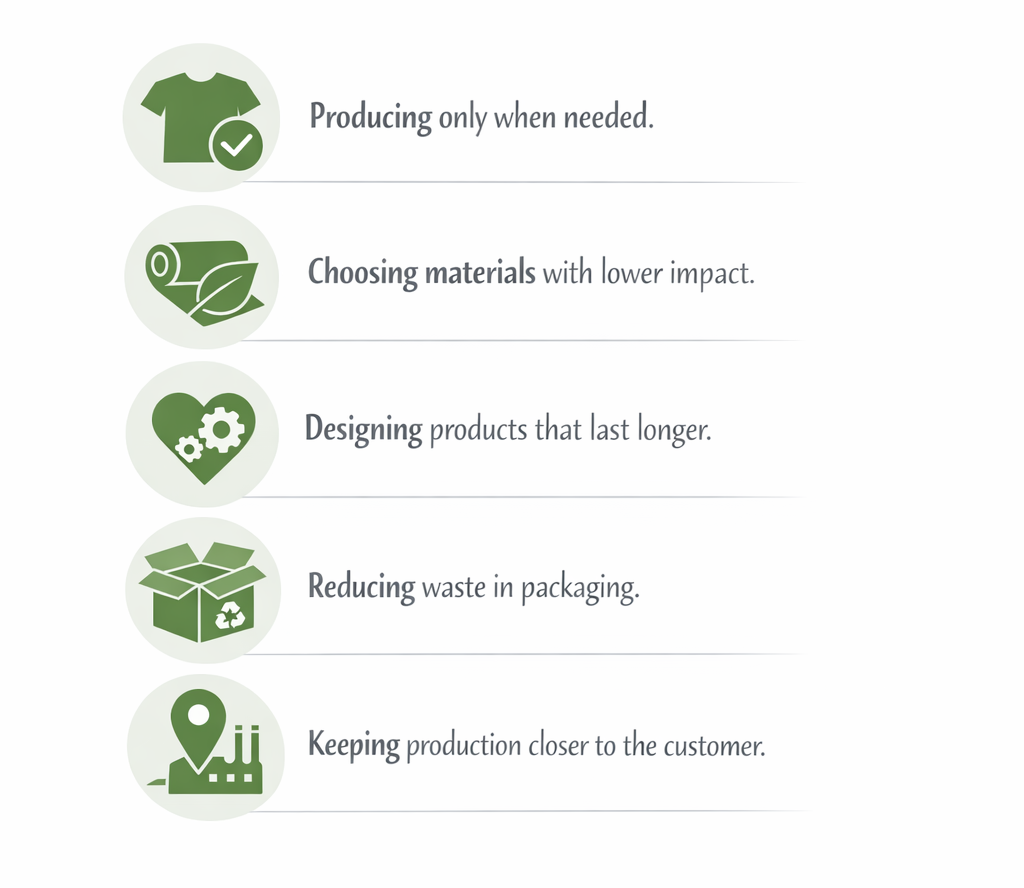
When these decisions come together, they shape a brand that is not just eco-friendly but also efficient and future-ready.
Final Thoughts: Sustainability is a System, Not a Feature
There is no single switch that makes a brand sustainable. It’s a direction.
Eco-friendly print-on-demand gives you a way to move in that direction without overcomplicating your process. It allows you to stay flexible, reduce waste, and build something that makes sense for both your business and the environment. You don’t need to do everything at once. But you do need to start.
If you’re looking to build a more thoughtful brand, start with how you produce, what you choose, and how you deliver. Small changes, done consistently, lead to something much bigger over time 🌱