
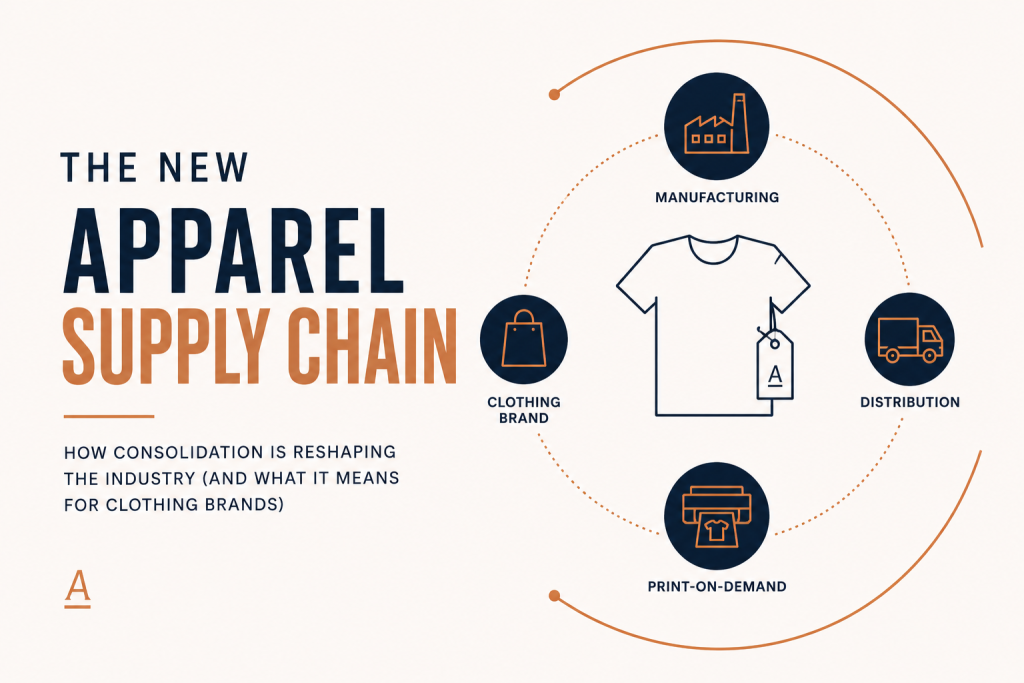
Most clothing brands recognize names like Comfort Colors, American Apparel, BELLA+CANVAS, and Hanes.
What many don’t realize is that several of those brands are now connected through a much smaller group of manufacturers and distributors than they were a decade ago.
As ecommerce accelerated and print-on-demand became mainstream, the apparel supply chain evolved alongside it. Manufacturers expanded through acquisitions, distributors built larger warehouse networks, and technology platforms began consolidating to meet growing demand.
For clothing brands, these changes are more than corporate headlines. They influence product availability, fulfillment speed, inventory consistency, and the resilience of the supply chain behind every order.
In this article, we’ll explore how the print-on-demand industry evolved, the acquisitions that reshaped it, and what those changes mean for brands building apparel businesses today.
A Decade of Consolidation
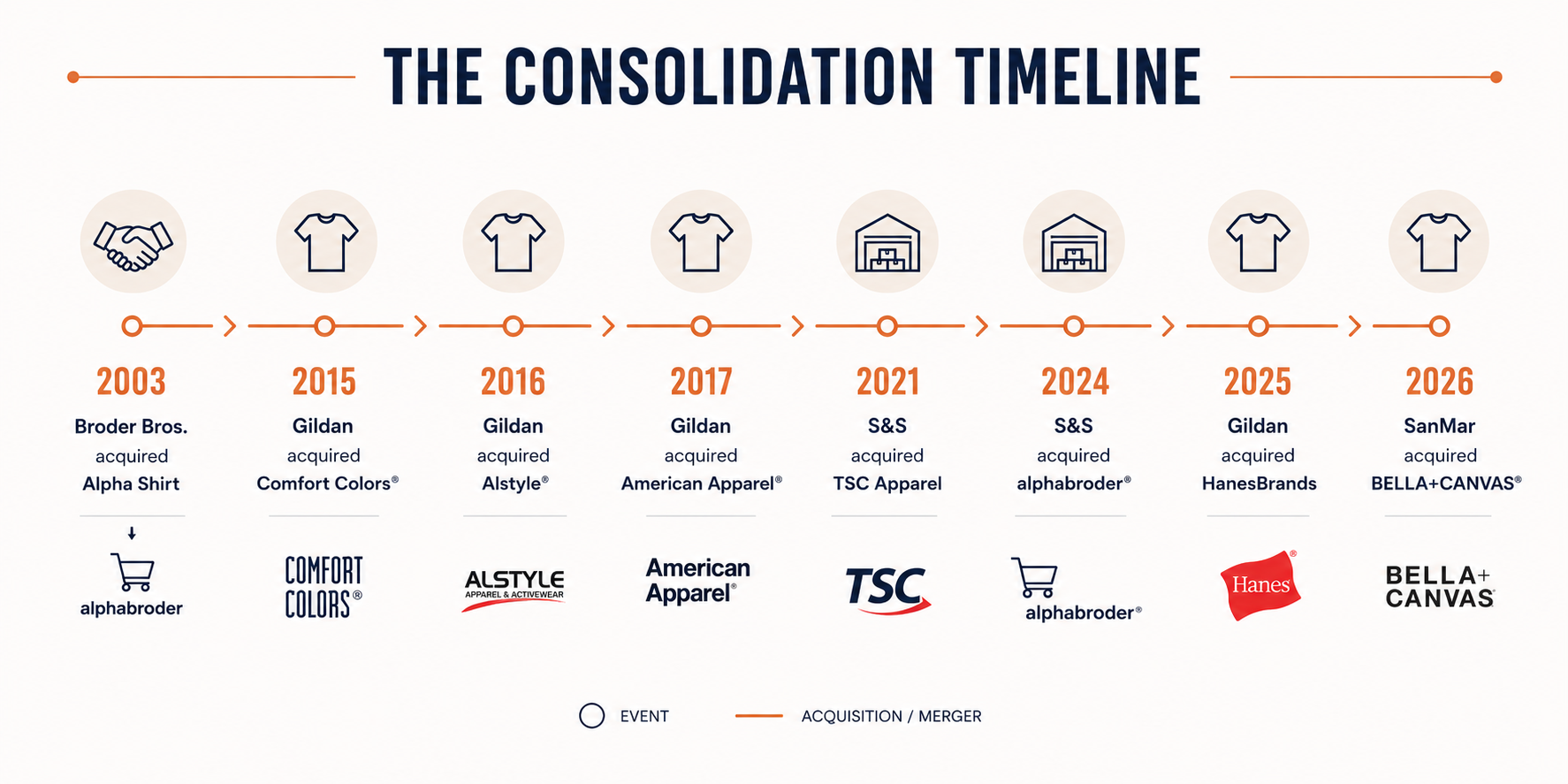
Over the past ten years, several acquisitions have fundamentally reshaped the apparel supply chain. Rather than replacing familiar brands, these deals often placed multiple well-known companies under the same corporate ownership.
Timeline of Major Industry Acquisitions
| Year | Transaction | Why It Mattered |
| 2003 | Broder Bros. acquired Alpha Shirt Company | Created the foundation for alphabroder, which later became one of North America’s largest wholesale apparel distributors. |
| 2015 | Gildan acquired Alstyle Apparel | Strengthened Gildan’s position in value-focused printable apparel. |
| 2016 | Gildan acquired Alstyle Apparel | Strengthened Gildan’s position in value-focused printable apparel |
| 2017 | Gildan acquired American Apparel | Added a fashion-oriented apparel brand with strong retail recognition. |
| 2021 | S&S Activewear acquired TSC Apparel | Combined two major distributors and expanded nationwide inventory and fulfillment capabilities. |
| 2024 | S&S Activewear acquired alphabroder | One of the largest distribution mergers in North American promotional apparel history. |
| 2025 | Gildan announced the acquisition of HanesBrands | Combined two apparel manufacturing giants under one corporate structure. |
| 2026 | SanMar acquired BELLA+CANVAS | Brought one of the industry’s leading premium blank apparel brands into SanMar’s distribution ecosystem. |
These acquisitions weren’t isolated events. Together, they reflect a broader shift toward larger, vertically integrated supply networks.
How Gildan Quietly Built One of the Largest Apparel Portfolios in the Industry
One acquisition rarely changes an industry. A decade of strategic acquisitions can.
Between 2015 and 2025, Gildan expanded far beyond everyday basics by acquiring some of the best-known names in blank apparel. Rather than building entirely new product lines, it strengthened its portfolio through established brands, giving clothing companies access to everything from value-priced basics to premium garment-dyed apparel under one corporate umbrella.
Today, Gildan’s portfolio spans everything from value basics to premium garment-dyed apparel, while also expanding into everyday apparel through HanesBrands. For brand owners, it means products that appear to come from different companies may now share the same manufacturing ecosystem.
Gildan’s Expansion Timeline
| Acquisition | Completed | Strategic Value |
| Comfort Colors | March 2015 | Entered the premium garment-dyed apparel market with one of the industry’s most recognizable lifestyle brands. (Acquired for approximately $100M.) |
| Alstyle Apparel | May 26, 2016 | Expanded Gildan’s presence in value-priced printable apparel while strengthening manufacturing capacity. (Acquired for approximately $110M.) |
| American Apparel | February 8, 2017 | Added a globally recognized fashion brand and expanded into premium retail-inspired basics. (Acquired for approximately $103M.) |
| HanesBrands | December 1, 2025 | Combined two of the world’s largest apparel manufacturers, significantly expanding scale, manufacturing, and product diversity. (Acquired for approximately $2.2B.) |
Rather than replacing these brands, Gildan largely preserved their individual identities. Comfort Colors still represents garment-dyed apparel, American Apparel continues to appeal to fashion-conscious brands, and Alstyle remains a trusted choice for value-oriented basics. Behind the scenes, however, they now benefit from shared manufacturing expertise, global sourcing, and larger operational resources.
Distribution Changed Just as Much as Manufacturing
While manufacturers produce blank apparel, distributors make those products available to decorators, print shops, and print-on-demand providers. Over the past years, distribution has consolidated through a series of mergers and acquisitions, creating larger warehouse networks, broader inventories, and more efficient fulfillment operations.
Before S&S, There Was alphabroder
The story began in 2003, when Broder Bros. acquired Alpha Shirt Company, creating the foundation for what would later become alphabroder. After unifying under a single brand in 2014, alphabroder grew into one of North America’s leading wholesale apparel distributors before being acquired by S&S Activewear in 2024.
S&S Expanded Its Distribution Network
S&S strengthened its national footprint by acquiring TSC Apparel in 2021 and alphabroder in 2024. Together, these acquisitions combined warehouse networks, inventory systems, and logistics into a single organization, making S&S one of the largest wholesale apparel distributors in North America.
For decorators, print-on-demand providers, and clothing brands, the result is a broader product catalog supported by a larger fulfillment network, helping improve inventory availability and order fulfillment across the U.S.
Major Distribution Changes
| Year | Transaction | Strategic Impact |
| 2017 | alphabroder acquired Prime Line | Expanded beyond apparel into promotional hard goods, creating a more diversified product offering. |
| 2021 | S&S Activewear acquired TSC Apparel | Significantly expanded S&S’s national warehouse footprint and customer base. |
| 2024 | S&S Activewear acquired alphabroder | Created one of the largest wholesale apparel distributors in North America. |
| 2025 | Prime Line relaunched under S&S | Returned as an independent hard goods division while remaining part of the S&S organization. |
Consolidation Expanded Beyond Manufacturing and Distribution
Consolidation is no longer limited to apparel manufacturing and wholesale distribution. Recent acquisitions show it’s also reshaping premium blank apparel and the technology that powers print-on-demand, creating a more connected supply chain from production to fulfillment.
SanMar’s Acquisition of BELLA+CANVAS
Unlike Gildan, which expanded primarily through acquisitions, SanMar spent decades building its own portfolio of private-label apparel brands including Port Authority, Sport-Tek, District, Port & Company, CornerStone, Mercer+Mettle, Allmade, and Volunteer Knitwear while also distributing leading retail brands. The BELLA+CANVAS acquisition expanded that ecosystem with one of the industry’s most recognized premium blank apparel brands.
SanMar’s acquisition of BELLA+CANVAS on June 29, 2026 marked a different kind of consolidation. Rather than absorbing the brand, SanMar kept BELLA+CANVAS operating independently while becoming its exclusive national wholesale distributor.
Founded in 1992, BELLA+CANVAS built its reputation on premium, retail-inspired blanks favored by fashion brands, creator merchandise, and print-on-demand businesses. The acquisition preserved that identity while strengthening its distribution through SanMar’s nationwide network.
What Industry Consolidation Means for Clothing Brands
The biggest changes in the apparel industry aren’t always visible to customers, but they influence everything from inventory availability to fulfillment speed. Here’s what consolidation means in practical terms for clothing brands.
1. More Reliable Product Availability – As manufacturers and distributors have grown, so have their inventory networks. Larger operations can better forecast demand, move inventory between warehouses, and keep popular products available, making it easier for brands to maintain consistent collections.
2. Faster Fulfillment – Expanded warehouse networks allow products to be sourced closer to production facilities, helping orders move through the supply chain more efficiently. For brands, that often means shorter production timelines and a more reliable customer experience.
3. More Product Choices- Consolidation hasn’t reduced product selection. Instead, larger distributors now offer broader catalogs that bring premium, performance, sustainable, and everyday apparel together in one place, giving brands more flexibility when building collections.
4. A Stronger Supply Chain – Recent investments in inventory planning, warehouse expansion, and logistics have made the apparel supply chain more resilient than it was just a few years ago. While disruptions can still happen, larger organizations are generally better equipped to respond to changing demand.
5. Choosing the Right Partner Matters More –As the supply chain becomes more connected, your print-on-demand partner plays a bigger role in product sourcing, decoration quality, and fulfillment. Working with an experienced partner helps ensure your brand can scale while delivering a consistent customer experience.
Are There Any Downsides?
Consolidation brings clear operational benefits, but it’s important to recognize the trade-offs as well. No industry change is entirely one-sided.
Potential Challenges
| Challenge | Why It Matters |
| Fewer major suppliers | Fewer companies control more of the industry’s infrastructure. |
| Less Competition | Higher prices are likely |
| Greater dependence on large organizations | Operational issues can affect a larger portion of the market. |
| Reduced competitive pressure | Less competition may influence pricing and product strategy over time. |
| Less diversity in ownership | Independent manufacturers and distributors face greater competitive challenges. |
Neither side tells the whole story. Consolidation isn’t inherently good or bad. It’s simply changing how the industry operates. For clothing brands, the most important question isn’t who owns what. It’s whether your supply chain is dependable enough to support long-term growth.
Final Thoughts
Over the last decade, the print-on-demand industry has become more connected than ever. Manufacturers, distributors, and technology providers have built a stronger supply chain that gives clothing brands better access to products, fulfillment, and scalability.
Even though ownership has changed, the fundamentals of building a clothing brand haven’t. Customers still judge your brand by product quality, design, fit, fulfillment, and experience—not by who owns the manufacturer or distributor behind the scenes. Understanding the supply chain simply helps you make better sourcing decisions as your business grows.
Explore Apliiq’s print-on-demand, custom apparel, warehousing, and fulfillment solutions to build a brand that’s ready to grow alongside an evolving industry.